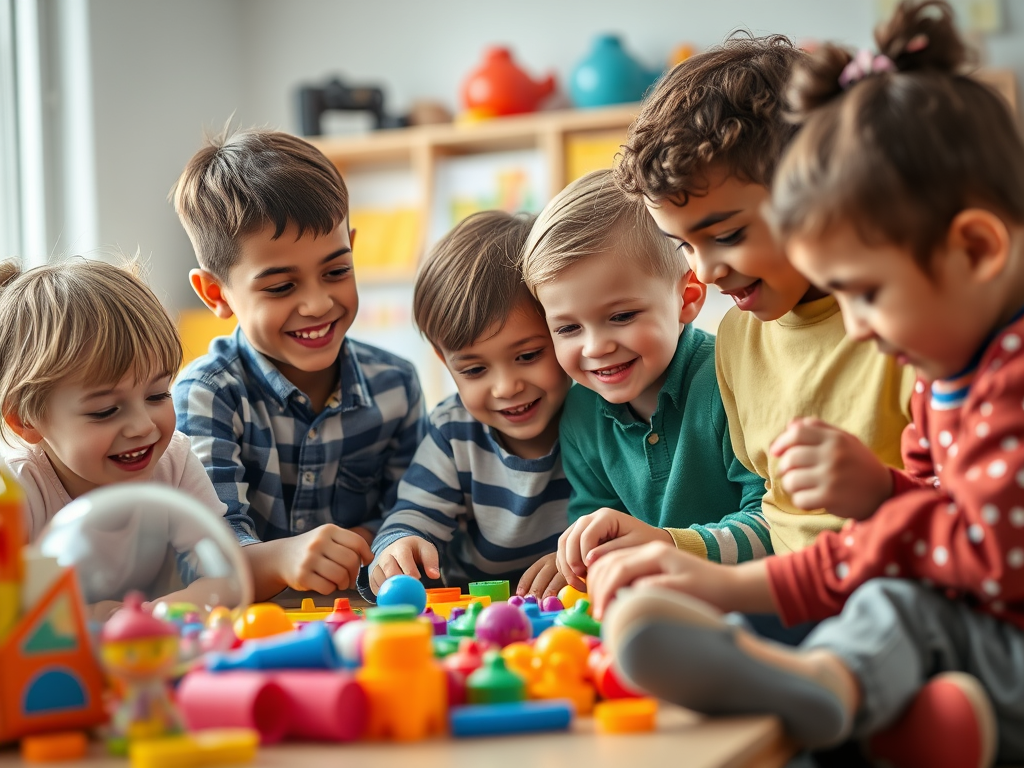
Learning Through Play

It may look like “just play"

Andria Englehardt is a preschool teacher with over 15 years of experience, passionate about play-based learning and its role in fostering creativity and social-emotional growth in young children. She is currently completing her Master’s in Early Childhood Education, focusing on observation, assessment, and the role of play in developmentally appropriate practice.

  • Andria Englehardt

    One of the most rewarding moments in early childhood happens when children are deeply immersed in play. Whether they are building block towers, negotiating roles in dramatic play or exploring the natural world around them, these moments reveal far more than play. They showcase learning in action through problem solving, collaboration, emotional regulation, and persistence. For educators, the challenge is capturing these moments through assessment while preserving the joy and authenticity of play.

    Why Play Matters for Assessment

    Play is a natural window into children;s development. It provides authentic opportunities to see how children apply social, emotional, and cognitive skills in real time. Research supports this approach. Wolf et al (2024) validated the Playful Learning Across the Years (PLAY) observational tool. It effectively captures children’s engagement, social connections, and emotional state during play. Demonstrating that play is not just a context for learning but a legitimate avenue for assessment.

    Challenges in Assessing Play

    Despite the benefits, many educators feel pressure to use more traditional methods of assessment. Families and administrators may ask how play connects to benchmarks. Teachers worry that pausing play for a checklist could disrupt children’s focus and joy.The key is finding ways to document and assess without interrupting the learning process.

    Strategies for Authentic Assessment
    • Embedding observation in routines by keeping anecdotal notes or digital portfolios.
    • Documenting the process, not just the product. How are children working together, solving problems, or persisting with a challenge?
    • Connect play to learning goals.
    • Communicating with families by sharing photos or captions to illustrate how play supports academic and social growth.
    Keeping Play Joyful

    Assessment through play should remain invisible t children, Instead of interrupting, teachers should watch, listen, and reflect. Offering comments to affirm the child;’s efforts and highlight the learning taking place. By embedding observation seamlessly, teachers maintain the integrity of play while still gathering valuable insights.

    Conclusion

    Assessment does not need to take away the joy of play. When teachers treat assessment as a natural part of their practice, play becomes both the pathway and proof of learning. This approach allows educators to meet accountability requirements while still honoring children’s right to joyful play experiences in the classroom.

    ______________________________________________________________________________________________________

    References:

    Wolf, S., et al. (2024). Examining the validity of an observational tool (PLAY) to assess support for engaged learning in early childhood. Early Childhood Research Quarterly, 69, 178–190. https://doi.org/10.1016/j.ecresq.2024.06.005

  • Andria Englehardt

    Have you ever watched children transform a pile of cardboard tubes, shells, and scarves into something completely unexpected? They could turn them into a rocket ship, a puppet theater, or even a city. Loose parts are everyday materials with no predetermined purpose. When placed in a child’s hand they become powerful tools for imagination and discovery. Loose parts support creativity, collaboration, and problem solving while giving educators authentic opportunities for observation and assessment (Cankaya, 2024).

    What Are Loose Parts?

    The idea of loose parts was introduced by Simon Nicholson in 1971. He proposed that the more variables and open ended materials children have, the more creative and inventive they become. Loose parts can be natural (pinecones ,stones,sticks), recycled (fabric, scraps, cardboard), or traditional classroom items (blocks, tubes, baskets). Their value lies in flexibility because the have no single “right” use. Children are free to invent, combine, and transform them in endless ways.

    Why Loose Parts Matter for Learning

    Loose parts create rich opportunities for:

    • Creativity: Children explore divergent thinking while creating unique ideas and solutions.
    • Problem-solving: Children test structures, adjust designs, and adapt materials when challenges arise.
    • Collaboration: Large scale projects often invite teamwork, negotiations, and shared leadership.
    • STEM exploration: Children are stacking, balancing, and arranging materials that introduce early engineering, measurement, and scientific inquiry.

    Recent studies have affirmed these benefits. Holmes et al. (2021) found that loose parts play fosters problem solving and cooperation in group settings. McClure et al. (2023) highlighted how open ended materials promote creativity and resilience, preparing children for complex learning tasks.

    Observation and Assessment in Loos Parts Play

    For educators, loose parts play is not only joyful, it is a window into development. Observing how children negotiate roles, persist through challenges, or test hypotheses offers authentic evidence of social emotional and cognitive growth.

    Strategies include:

    • Taking anecdotal notes during play to capture decision making and problem solving
    • Using photos to document the process as well as the product
    • Linking observations to developmental goals

    Wolf et al. (2024) validated the Playful Learning Across the Years (PLAY) tool. Their findings show that structured observation frameworks can successfully capture children’s engagement. They also capture social connections during loose parts play.

    Practical Tips for Educators
    • Start small: collect everyday materials like bottle caps, fabric scraps, or sticks
    • Organize items in baskets or trays so children can combine and experiment freely.
    • Rotate materials regularly to spark new interest.
    • Offer indoor and outdoor opportunities for loos parts exploration.
    • Involve families by inviting donations of safe, reusable items.
    Conclusion

    Loose parts are more than materials, they are catalysts for learning. They provide children with freedom to create, experiment, and collaborate in ways that foster imagination and critical thinking. For educators, they offer authentic opportunities to observe growth in problem-solving, communication, and persistence. In today’s educational climate, pressure to meet standards can overshadow child-centered practice. Therefore, loose parts play is more important than ever. It reminds us that meaningful learning is not always captured in worksheets or tests. Instead, it is found in the joyful exploration of a child stacking, building, and imagining. By embracing loose parts, we create classrooms where creativity thrives. Children’s voices are honored. Play is recognized as both the process and the evidence of learning. What loose parts could you introduce into your own classroom tomorrow, and what learning might you see unfold?

    References:

    Cankaya, O., Leach, J., & Akdemir, K. (2024). The journey of loose parts across educational landscapes and history: the role of materials, relationships, space, and time in children’s loose parts lay. American Journal of Play, 16(2-3), 210-245

    Holmes, R., Pellegrini, A., & Schmidt, S. (2021). Loose parts play and its role in promoting problem-solving and collaboration. Journal of Playwork Practice.

    McClure, E., Guernsey, L., & McCann, C. (2023). Play and creativity in early childhood classrooms. Early Childhood Research Quarterly.

    Wolf, S., et al. (2024). Examining the validity of the PLAY observational tool to assess support for engaged learning in early childhood. Early Childhood Research Quarterly, 69, 178–190. https://doi.org/10.1016/j.ecresq.2024.06.005.

  • Andria Englehardt

    Walk into any preschool classroom and you will most likely see children engaged playing, building towers, negotiating roles in dramatic play, or experimenting with water and sand. To an outside observer, it may look like “just play.” But for educators, these moments show rich opportunities for learning across cognitive, social-emotional, and physical domains.

    Yet many of us, as preschool teachers, face the challenges of balancing the developmental importance of play with the growing pressure of standards, mandated curricula, and kindergarten readiness expectations. The pressure is real: how do we remain faithful to what we know about childhood development while also meeting accountability measures?

    Why Play Matters

    Play is central to how children learn. Piaget (1952) described children as active constructors of knowledge through exploration, while Vygotsky (1978) emphasized the role of social interaction and scaffolding in cognitive growth. Today, research and professional organizations reaffirm these understandings. The National Association of the Education of Young Children (NAEYC, 2020) highlights play as a cornerstone of developmentally appropriate practice, reminding us that it supports problem-solving, language, collaboration, and self regulation.

    Meeting Standards Through Play

    The good news is that standards and play are not mutually exclusive. Learning frameworks outline what children should know and can do, but they leave very little room for flexibility in how those goals are achieved. That’s where play becomes essential!

    For example:

    • Block play supports math concepts like geometry, spacial reasoning, and measurement.
    • Dramatic play naturally integrates literacy skills through vocabulary building and storytelling.
    • Outdoor exploration encourages science learning through observation, inquiry, and cause and effect reasoning.

    When educators enter play with intentional prompts or guiding questions, they connect playful experiences with authentic, joyful experiences that bridge academic expectations.

    Practical Strategies

    Educators can:

    • Create intentional environments that invite exploration connected to leaning goals.
    • Use observations as assessments by documenting evidence of standards met during play.
    • Communicate with families and administrators to highlight how play based learning achieves benchmarks.
    • Advocate collectively by sharing examples of how play aligns with standards to perception that play is “extra”.
    Conclusion

    As educators, our role is not to choose between play and standards. Instead, we weave them together with intention, creativity, and purpose. Play provides the context where curiosity meets curriculum. Children explore, problem-solve, and collaborate. They also meet important developmental and academic goals. We ground our practice in research and developmental theory. We align our work with current standards. This ensures that learning is both rigorous and joyful.

    Play is not optional or an “extra.” It is the heart of early education. Play is a proven pathway to social-emotional growth, cognitive development, and lifelong learning. By embracing play as both the method and the evidence of learning, we prepare children for school. It also prepares them for life.

    References:
    National Association for the Education of Young Children. (2020). Developmentally appropriate practice position statement. https://www.naeyc.org/resources/position-statements/dap.

    Piaget, J. (1952). The origins of intelligence in children. International Universities Press.

    Vygotsky, L. S. (1978). Mind in society: The development of higher psychological processes. Harvard University Press.